

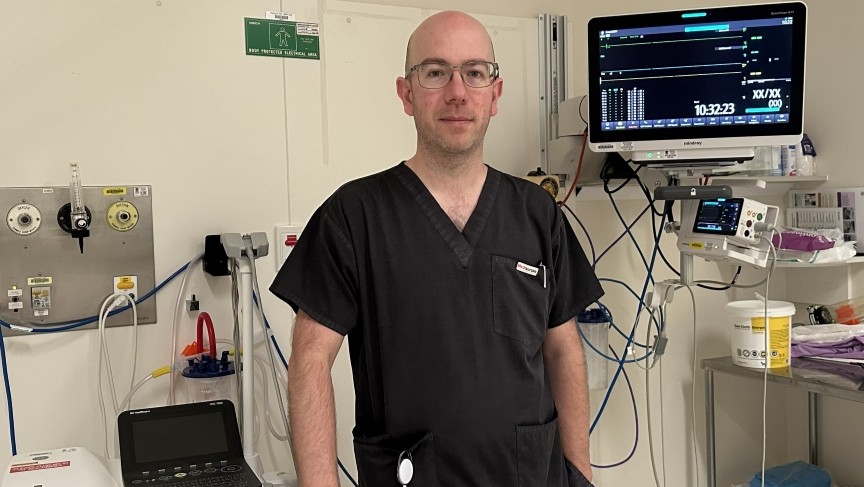
Receiving a Queensland Health Clinical Research Fellowship (Novice) award is helping Wide Bay Hospital and Health Service (WBHHS) Staff Specialist Dr Tom Papior take the next step in improving treatment options for people living with migraine.
The grant will enable Dr Papior to conduct a pilot study for investigating intravenous lignocaine as a treatment for acute severe migraine in Bundaberg Hospital’s emergency department.
Delivering the study will see Dr Papior collaborating with his emergency department colleagues, bringing together clinical care and research.
“Current treatment options can cause side effects such as sedation and low blood pressure,” Dr Papior said.
“We are investigating whether lignocaine could provide effective pain relief with fewer side effects.”
Dr Papior explained lignocaine has shown increased use for the management of acute pain for other conditions such as renal colic and burns. It is also currently used for chronic problematic migraines in the inpatient setting delivered by neurologists.
“There has not been much research looking at its use in the emergency department for acute migraines, so the aim is to have patients consent to receiving lignocaine instead of our usual treatment options and see if it’s effective.”
For Dr Papior, the inspiration for this pilot study came from the knowledge that migraine is estimated to affect more than one in 10 Australians, with severe attacks leading people to seek emergency care when their usual medications have not worked.
“Migraine is not a problem unique to the Wide Bay but the local focus is on investigating a treatment approach in the setting where we would actually use it,” he said.
“This is so we understand its practicalities as well as its potential benefits.
“Ultimately, I would like patients to have another treatment option that provides effective migraine pain relief with fewer side effects.
“If a treatment could also reduce the time patients need to spend in the emergency department, that would be a further benefit.”
A longer-term goal for Dr Papior is to use the pilot findings to develop a multicentre randomised trial which would involve collaboration with researchers and clinicians at other hospitals.
“This pilot is an important first step towards establishing whether that larger study is warranted,” Dr Papior said.
“The immediate goal is to obtain useful early information about pain relief and tolerability to guide a larger trial.”
Dr Papior said the project also creates an opportunity for local patients and clinicians to contribute to research close to home.
“I think it is important that regional hospitals help generate the evidence that informs care, rather than only applying findings from studies conducted in large metropolitan centres.”
Dr Papior appreciates the support from Queensland Health, Wide Bay Hospital and Health Service, and the Bundaberg Emergency Department team. The patients who choose to participate will also make an essential contribution.
“It is very encouraging to receive this support, both for the project itself and for my development as a clinician researcher,” Dr Papior said.
“The most valuable part is having dedicated time to focus on my own research project rather than solely contribute to studies run outside of Wide Bay.
“The Fellowship award is also an investment in regionally led research. I would like this project to contribute not just to the treatment of migraine, but also to our capacity to develop and lead further research here in Bundaberg.”