
As Queensland battles the highest skin cancer rates in Australia, the Wide Bay region was a highly relevant setting for an international study advancing new treatments for squamous cell carcinoma (SCC).
Through its public, private partnership (PPP) Wide Bay Hospital and Health Service and Genesis Care delivered treatment to patients who agreed to take part in this trial in Bundaberg and Hervey Bay.
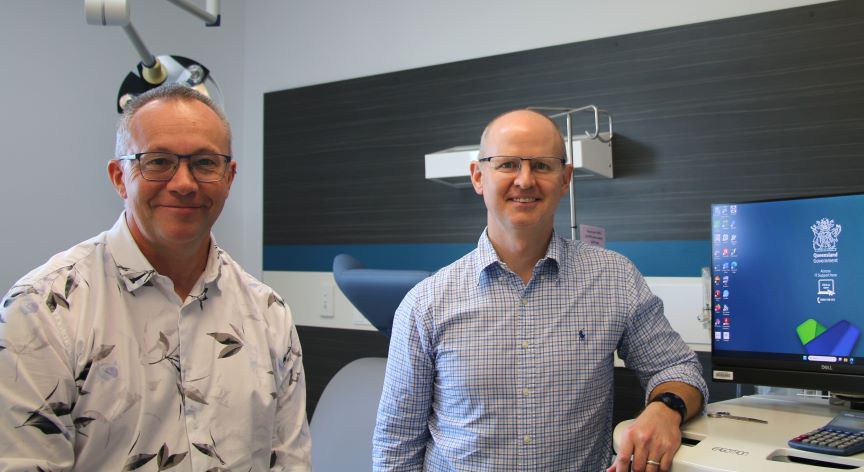
Managed through the Wide Bay Oncology Trials and Research Steering Group (WBOTRSG) a total of 22 participants from the Wide Bay region were recruited. Both local lead investigators, Dr Hayden Christie - Hervey Bay and Dr Gerry Adams - Bundaberg, were among the authors for the initial findings of the study, recently published in the New England Journal of Medicine.
Dr Adams said that the results of this International Phase III trial known as C-POST for the first time, showed that offering immunotherapy after surgery and radiation therapy can stop skin cancer from returning in high-risk patients.
“The trial results showed 87% of patients were disease free for two years after use of the immunotherapy drug in combination with usual treatments,” he said.
“The results are potentially practice changing and may lead to new treatment methods for patients with high-risk cutaneous squamous cell cancer.
Dr Christie explained that immunotherapy increases the body’s own defence system to find and destroy cancer cells.
“Immunotherapy is a rapidly evolving field of cancer treatment. We are researching more ways to use immunotherapy in different types of cancer, at different stages, both alone and in combination with other cancer treatments,” Dr Christie said.
“We already understood the benefits of this immunotherapy drug in skin cancer patients, where the cancer had spread and was not curable with surgery or radiation therapy.
“This study shows that for patients where the cancer has not spread widely, but who are at high risk of it coming back, the risk of disease recurrence is reduced by adding this immunotherapy treatment earlier.”
Dr Christie added that the trial also revealed important information about the safety of the drug.
“We already know a lot about the side effects of immunotherapy and how to manage them,” he said.
“The good news about this trial is that the assessment of safety was as expected. Some patients experienced side effects, with some stopping the treatment because of that.
“The safety profile results were in the range that we would expect with this type of treatment.”
Dr Adams said that the local research group had been involved in the trial since its early days in 2019 all the way through to 2024, when enrolment to the trial closed.
“This was the first big trial for our research group. It showed a level of trust in us for a small region like ours to be involved with not much previous trial experience,” he said.
“We’re all proud to be a part of a local team that’s able to offer access to international clinical trials and increase treatment options for local patients.”
Overall, throughout the study, more than 400 trial patients received regular intravenous infusions of the immunotherapy drug (cemiplimab) or placebo over a 12-month period and continue to attend long-term follow-up appointments with the research team.
The research paper ‘Adjuvant Cemiplimab or Placebo in High-Risk Cutaneous Squamous-Cell Carcinoma’ is available online here.

Local lead investigator Bundaberg -
Dr Gerry Adams (Genesis Care)