

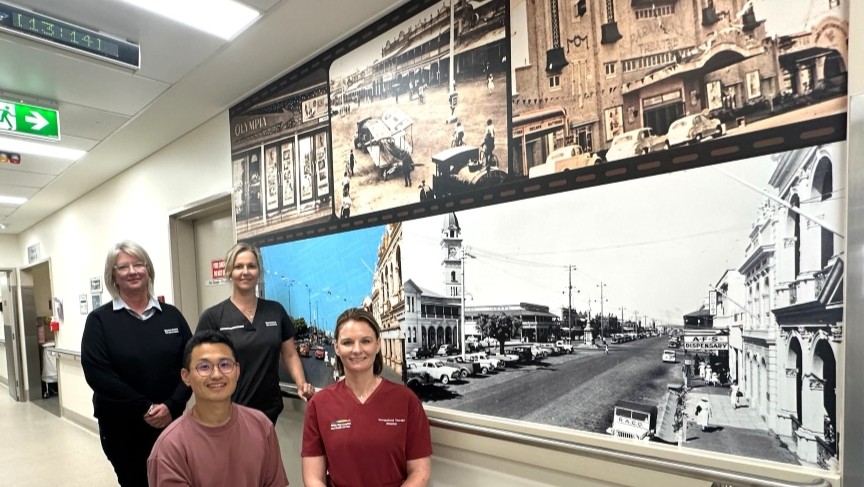
An innovative idea first pitched through Wide Bay Hospital and Health Service’s (WBHHS) annual Buzz Pitch program is now making a meaningful difference for patients, with the Memory Lane project transforming part of the surgical ward into a space that encourages movement, connection and recovery.
The WBHHS Buzz Pitch program supports staff to present and progress innovative ideas that improve patient care, staff experience or organisational outcomes.
Submitted by the Eat Walk Engage team in 2025, Memory Lane was selected for implementation by a panel of HHS Executive, HHS Board, HHS Leadership and Community Reference Group members.
The initiative was developed in response to a common challenge in hospital care: helping patients stay mobile, mentally engaged and socially connected during their admission.
Ben Kim, Eat Walk Engage Program Facilitator, said the idea grew from recognising that the hospital environment itself can play an important role in recovery.
“Many older patients spend long periods sitting or lying in bed, often with limited opportunities for meaningful movement, cognitive stimulation and social interaction,” Ben said.
“We wanted to create an environment that encouraged patients to get out of their rooms, walk a little further, reminisce about Bundaberg’s history and naturally start conversations with family, visitors and staff.
“Rather than simply decorating a corridor, our goal was to use the environment as another way of supporting recovery.”
Ben said Memory Lane also reflects the broader principles of Eat Walk Engage, a delirium prevention program that focuses on supporting older patients through optimal nutrition and hydration, early and progressive mobility, and meaningful cognitive and social engagement to promote a speedier recovery.
Memory Lane features contemporary and historic images of the Bundaberg region, creating a visual journey that reflects the local community and invites patients to engage with familiar places, stories and memories.
Janine Bignell, Eat Walk Engage Multi-Professional Assistant, said the project was carefully designed to maximise its impact on patients, visitors and staff.
“The Memory Lane walk takes you from images in North Bundaberg to over the Burnett Bridge, through town and out to our coastline and reef, including Bargara, Moore Park Beach, East Bundaberg and the Hummock,” Janine said.
“It captures farming and iconic images of Bundaberg, past and present.”
Janine said including local imagery was an important part of helping patients feel a sense of belonging and connection.
“We have seen patients reflect on and connect with the eras that have been captured and heard their comments, even if they were living somewhere else in Australia during that era,” she said.
“The buildings, the cars, the fashion and the activity all spark memories and conversation.”
The final images were selected through consultation with stakeholders, with staff and consumers helping choose from a shortlist of more than 60 images representing the ecological and historical diversity of the Bundaberg region.
As well as creating a more welcoming and engaging ward environment, the project aims to motivate patients to move where appropriate, whether independently, with assistance or in a wheelchair.
“Our aim is for patients to feel motivated to get up and get moving, for it to be a talking point for visitors, for staff to be able to use it as a tool of diversion with patients, for stories to be shared, and to be distracted for a while from the acute care setting and unfamiliar busy environment of hospital,” Janine said.
The project took around 12 months to bring to life and involved strong collaboration across teams.
Pitching the Memory Lane idea alongside Ben was Clinical Nurse Coach Roselea McHale who shared her pride in seeing the project become reality.
“It has been incredibly rewarding to see the project move from an idea into a real feature on the ward and watching people admiring the space as they walk around,” Roselea said.
“Being able to start a conversation with a patient, visitor or staff member simply by looking at an image is a wonderful outcome and helps create a more welcoming and connected environment.”
Ben acknowledged the many people involved in bringing Memory Lane to life, saying it reflected the contributions of the wider Eat Walk Engage team, nursing staff, allied health clinicians, facilities, communications, Arts in Health expertise and hospital leadership.
“Every stage required collaboration, and recognising everyone’s contribution reinforces that sustainable improvements in healthcare are achieved through teamwork rather than individual efforts,” he said.
Memory Lane is a strong example of how simple, thoughtful changes can have a real impact on patient experience.
“Sometimes, relatively simple environmental changes can positively influence mobility, engagement and patient experience,” Ben said.
“Supporting frontline staff to test and develop their ideas can lead to practical improvements that genuinely make a difference for patients.”