

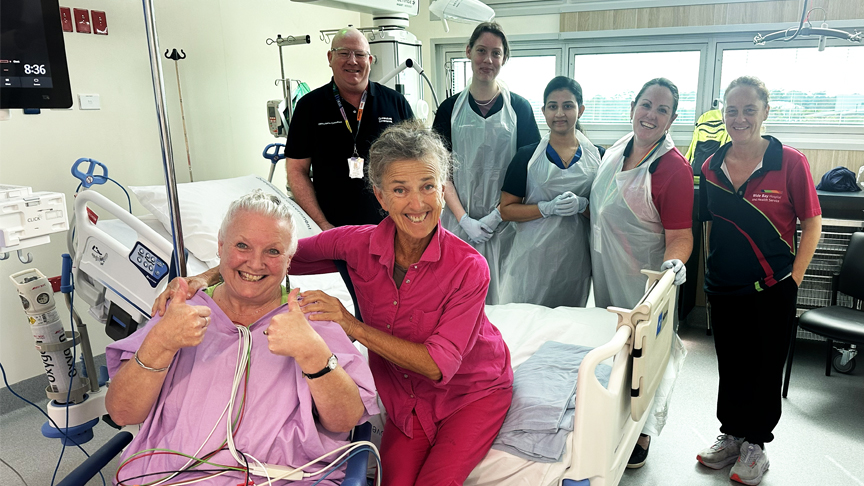
Volunteers recently played an important role in helping Hervey Bay Hospital staff test the new intensive care unit (ICU) and medical ward environments through a series of simulation exercises.
Local Hervey Bay hospital volunteers partnered with the hospital's education, simulation and clinical teams, developing and participating in realistic scenarios to help staff provide a safe, accessible and welcoming environment.
Working in small groups, volunteers stepped into the roles of patients, family members and carers, testing everything from how easy visitors found it to navigate the new space, through to a full emergency evacuation.
The simulations involved staff from across the hospital, including nursing, medical, allied health, administration, environmental services, food services, security and patient support teams.
Hervey Bay Hospital Nurse Educator Janette Barnes said involving volunteers in the exercises provided valuable insights that helped refine processes ahead of patients moving into the new spaces.
"We tested everything from patient transfers and emergency responses to wayfinding, visitor experiences and difficult family conversations, and it gave us confidence our teams were prepared while also identifying opportunities for improvement,” Janette said.
“For example, one valuable learning came from testing patient transfers using the new ceiling hoists, where a consumer told us they felt uncomfortable and exposed during our initial transfer.
“We immediately trialled a different approach, which all other volunteers found much more comfortable and private, and it has since been incorporated into staff training."
Janette said the simulations also identified that when clinicians are concentrating on new equipment and processes, communication with patients can sometimes unintentionally become a secondary focus.
“As a result, during the first few days after opening we used a double-nursing approach in the ICU, with one nurse focussing on patient communication and the other concentrating on equipment and clinical tasks, which proved to be very successful.
"The consumers' acting skills were spectacular and their involvement helped challenge our assumptions about the patient and family experience. They uncovered insights we may not have identified until a real event occurred, allowing us to make improvements before patients entered the space."
Volunteer Debbie Allen said being involved in the development and delivery of the simulation scenarios provided a valuable opportunity to contribute to future patient care.
“It was great to see consumers and volunteers actively involved in the simulations,” Debbie said.
“There were a few little kinks identified, but that’s exactly why we were there, to help iron them out, and the staff were very receptive to our feedback and acted on it straight away.
“Including people with lived experience is so important. A manikin can’t respond or provide feedback, but a real person can. We can bring a different perspective and help staff understand how procedures and equipment feel from a patient’s point of view.
"Staff were understandably a little nervous using the new equipment with us at first, but I’m sure the simulation exercises have helped build their confidence. They asked plenty of questions, which showed how committed they are to doing things safely and getting it right for patients."
The simulation exercises formed part of the Hervey Bay Hospital Expansion project, supporting staff readiness and helping refine patient care processes before the new facilities opened in late September 2026. To learn more about the project, visit: https://www.widebay.health.qld.gov.au/hospitals-and-health-centres/hervey-bay-hospital/hervey-bay-hospital-expansion.
For more information on becoming a consumer representative or volunteer, visit https://www.widebay.health.qld.gov.au/about-us/get-involved.