
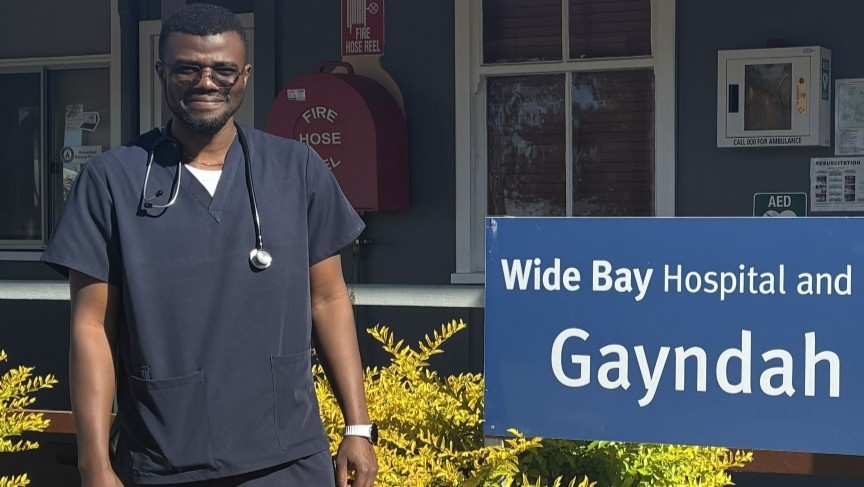
 Dr Emmanual Ofili is looking forward to contributing to the Gayndah community through his role at the Gayndah Hospital.
Patients in the rural community of Gayndah are set to benefit from a wealth of clinical experience with the permanent appointment of Gayndah Hospital Medical Officer Dr Emmanual Ofili.
This is welcome news for staff and the community who have not had a permanent medical officer at the hospital for several years. While locums have previously filled the role, it is not always easy to attract doctors to rural and remote areas on a permanent basis.
Dr Ofili brings with him extensive clinical experience after working in Nigeria across general medicine, surgery, emergency and primary care before moving to Botswana to work in general practice. From there he moved to New Zealand, where he worked in Gisborne across emergency medicine, general medicine, general surgery and general practice before taking up a position in Australia in the Emergency department at Mackay Base Hospital.
He is currently undertaking specialist training in Rural Generalist Medicine through the Australian College of Rural and Remote Medicine (ACRRM) which led to his current role with Wide Bay Hospital and Health Service.
Dr Offili’s experience across different countries, cultures and healthcare settings has shaped his interest in providing broad, practical and patient-centred care, particularly in rural communities.
“Rural medicine has always appealed to me because of the variety of medicine involved and the opportunity to become genuinely connected with the community you serve,” Dr Ofili said.
“Gayndah particularly attracted me because the role allows me to work across both hospital and general practice settings.
“I enjoy the continuity that comes with being able to see patients in the community, manage their ongoing health needs and care for them when they require hospital treatment.
Dr Ofili said it also fits very well with his Rural Generalist training.
“I wanted somewhere I could develop not only as a doctor but as a clinician capable of managing the broad range of presentations that come with working in a rural community,” he said.
“Ultimately, I would like my contribution to be measured not simply by the number of patients I see, but by whether people feel they have accessible, consistent and good-quality healthcare close to home.”
For Dr Ofili, rural medicine was an important part of his medical experience while in Nigeria having worked in a rural primary healthcare setting where access to specialist services and investigations could be limited.
“That experience taught me the importance of clinical judgement, resourcefulness and understanding the circumstances of the patient beyond their immediate medical problem,” he said.
“Caring for a regional population in New Zealand gave me further exposure to rural and community-based healthcare, including working with Maori communities.
“One thing I have learned from working in different parts of the world is that while healthcare systems may be different, what patients want from their doctor is remarkably similar: they want to be listened to, treated with respect and confident that someone genuinely cares about what happens to them.”
Dr Ofili said these experiences have shown him that rural medicine can be challenging, but also incredibly rewarding. Developing stronger continuity with patients and their families has given him an appreciation of how important a reliable local health service is to a community.
“Medicine is not only about treating an illness; understanding the person, their family and the community they live in can make an enormous difference to their care.”
Dr Ofili has moved to Gayndah with his family and from a personal perspective feels there is something meaningful about becoming part of a smaller community. To him It’s more than taking another hospital position.
“It’s an opportunity to establish myself within a community, contribute to it and hopefully grow alongside it.”