

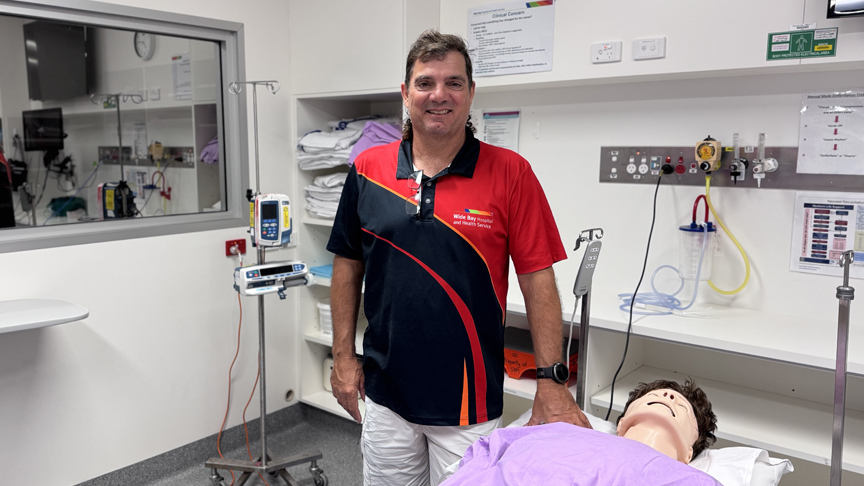
When Hervey Bay Hospital’s current Intensive Care Unit (ICU) first opened its doors, Christopher Barnes, Nurse Educator, Simulation, was one of the very first clinicians to step inside.
Eager to make a difference, he spent the early years of his career learning every corner and every workflow of the unit that would become his professional home.
Now, decades later, Chris will soon be preparing the next generation of staff to step into a new home of their own – running a series of simulation-based training sessions to get them ready for the big move.
Chris said simulation played a crucial role in preparing a new area for opening, with the sim team carefully inspecting the layout then running a series of timed, multidisciplinary scenarios.
“As an example, before we opened our new Medical Ward 3 last year, we used our simulation scenarios as search‑and‑find exercises – we set up a deteriorating patient, and staff had to locate the ECG machine, the resuscitation trolley and other key pieces of equipment,” Chris said.
“It’s one thing for me to point to something and say ‘this is where it is’, but it’s completely different when you’re under pressure and have to find it yourself.
“Doing it in a realistic, time‑pressured situation, which simulation can provide, is far more effective than a PowerPoint presentation where I’m just giving facts.
“We always debrief afterwards to talk about what worked well and what was challenging, and we remind staff that we’re always available to chat, answer questions or go over anything they’re unsure about.”
Chris said the joy in simulation wasn’t the one simulation session itself – it was seeing change over time.
“You can run a simulation beautifully, but that only shows what you know today – simulation works because it’s a story the staff get to be a part of,” he said.
“When I come back months later to hold another simulation session and watch how people’s behaviour and knowledge have grown, that’s incredibly rewarding. What’s really cool is when they throw my own words back at me during a scenario, because it tells me that the learning has stuck.”
When asked what excites him most about the new ICU, Chris said it was watching the service evolve into a purpose‑built 10‑bed unit, along with the growth of the people within it.
“I was here when the first ICU opened with just a small number of ICU beds, I saw the shift to having specialist intensivists on site to lead care, then more beds added, and eventually the space becoming busier and stretched beyond what it was originally designed for,” he said.
“Some of the nurses working in ICU today were new graduates or just beginning their ICU careers when I was leaving. Now they’re the experienced ICU nurses guiding others, and that’s pretty special.”
As part of the Hervey Bay Hospital Expansion, scenario‑based simulations will give staff a real‑world preview of their new spaces and workflows, building confidence before patients arrive.
The full suite of scenarios is being finalised and will roll out later this year as part of the induction program, strengthening staff understanding of the models of care, processes and equipment that will support day‑to‑day work in the new environment.