

Wendy Newton is usually hidden working in the Recovery Room at the Bundaberg Hospital but is currently seconded to the Nursing and Midwifery Education Team as Acting Perioperative Nurse Educator.
In an earlier edition of the Wave, we learnt how Wendy completed her PhD in November 2024. Her thesis passed with no revisions and was considered in the top 10% by both examiners. Recently she was notified that she was awarded the Paul Andersen FAPEx Research Prize.
The prize is awarded for the highest thesis result in the academic year.
Education and Training Nursing Director Cheryl Steers said to be considered for the award Wendy's thesis had to be considered in the top 10% in its field by at least one examiner, pass with minor or no revisions, which is rare, and complete on time, 3-4 years full-time or the part-time equivalent.
The final decision for the award is made by the Research Committee.
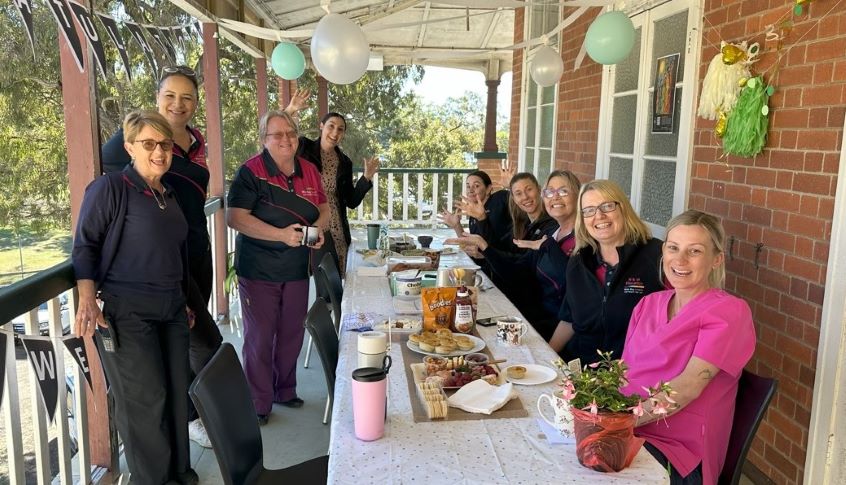
The Nursing and Midwifery Education and Simulation team at Bundaberg Hospital recently celebrated Wendy’s achievement with a morning tea.
“The team was excited to celebrate this academic achievement,” Cheryl said.
“We are incredibly proud of Wendy, with this award a reflection of hard work, perseverance, and excellence.
“One interesting fact is Wendy trained at the Bundaberg Hospital completing her training in January 1988.
“Her academic credentials include a Grad Cert and a Cert IV (Behavioural Dog Training) although most people who start a PhD have a Master’s degree with at least a year of research as part of the degree.”
Cheryl said supervisors Professor Jenni Judd and Professor Tania Signal were a key part of her success.
As was the financial support provided through the Beth Cuthbertson Scholarship awarded by the Australian Nurses Memorial Centre.
Wendy’s thesis examined the inclusion of animals in Australian residential aged care facilities and analysed the legislation, policies and practices through a One Health One Welfare lens.
The thesis included five publications and a conceptual framework that is being developed into another article. Wendy and her team hope to secure a research grant to undertake further research allowing for the development of guidelines and facility specific policies for including animals in residential aged care facilities.
There is additional scope to use the proposed framework in other venues such as home-based aged care and over 55’s villages. It is likely that the framework will have national and international impact in the animal-assisted interventions sector.
Wendy encourages anyone thinking about a research higher degree to reach out to her or she would love to provide moral support to anyone completing a research degree.
Her catch phrase is “If I can: You can too.”
Her publications are free to download below:
Wendy Newton, Tania Signal, Jenni Judd. The policies and guidelines influencing animal-assisted activities in aged care: a systematic integrative review. PROSPERO 2024 Available from https://www.crd.york.ac.uk/PROSPERO/view/CRD42020150440
Newton, W., Signal, T., & Judd, J. (2021). The guidelines and policies that influence the conduct of Animal-Assisted Activities in Residential Aged-Care Facilities: A systematic integrative review. Complementary Therapies in Clinical Practice, 44, 101395. https://doi.org/10.1016/j.ctcp.2021.101395
Newton, W., Signal, T., & Judd, J. A. (2022). Fur, fin, and Feather: Management of animal interactions in Australian residential aged care facilities. Animals, 12(24), 3591. https://doi.org/10.3390/ani12243591
Newton, Wendy (2024). Animals in Australian Residential Aged Care Facilities: Provision, Policy, and Practice. CQUniversity. Thesis. https://doi.org/10.25946/28051229
Newton, W., Signal, T., & Judd, J. (2024). Both Ends of the Leash: Animals in Australian Residential Aged Care Facilities, Views of Experienced Animal Trainers/handlers Working in Residential Aged Care Facilities. Journal of Applied Animal Welfare Science, 1-14. https://doi.org/10.1080/10888705.2024.2411551
Newton, W., Signal, T., & Judd, J. A. (2025). The Legislation for Providing Animal Access in Australian Residential Aged Care: It's Not a Zoo. Australian Journal of Social Issues. https://doi.org/10.1002/ajs4.70052