

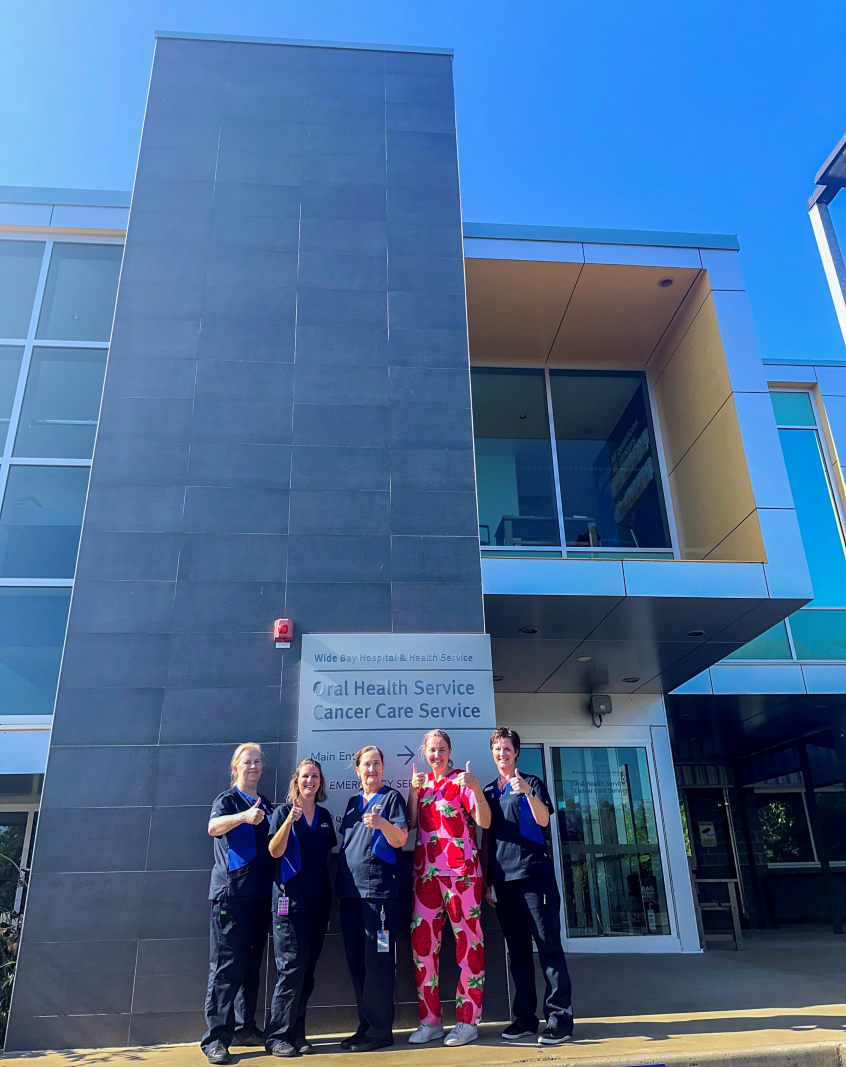
Wide Bay Hospital and Health Service is now producing more renewable energy and reducing its power costs and greenhouse gas emissions, thanks to the installation of three new rooftop solar energy systems at facilities across the region.
The systems were installed at the Bundaberg Oral Health and Cancer Care Centre, Mundubbera Multipurpose Health Service (MPHS) and Biggenden MPHS, after a feasibility study conducted last year recommended they be fast-tracked due to their strong viability and good natural positioning.
The installations were co-funded through Queensland Health’s $30 million Emissions Reduction Program, which helps hospital and health services to implement energy and cost-saving initiatives and supports the financial sustainability of local healthcare delivery.
The solar switch-on comes as WBHHS prepares to present alongside three other Queensland Health services later this month to the national Climate + Health Summit, which gathers stakeholders from health, community, government and industry to collaborate for sustainable, resilient communities.
WBHHS Chief Executive Debbie Carroll said the three solar projects were installed throughout June and had now been commissioned and switched on following final approval from Ergon Energy.
Electricity data from their first month of operation shows year-on-year reduction in grid consumption and greenhouse gas emissions as follows:
- Bundaberg OHCC: Consumption down 15.8%
- Biggenden MPHS: Consumption down 27.8%
- Mundubbera MPHS: Consumption down 24.4%
Onsite emissions reductions were proportionate to the drop in consumption, boosted by ‘greener’ purchased electricity reducing emissions further thanks to the increase of renewables in the grid.
“We’re conscious of the impact our health facilities have on the environment, so it’s been exciting to see these solar projects help reduce that impact by generating more renewable energy onsite,” Ms Carroll said.
“As a publicly-funded service, it’s also crucial that we operate as efficiently as possible. These systems instantly help us to save on electricity costs and are projected to pay themselves off entirely within a few years.”
Sustainability strategy
The solar projects form part of a comprehensive set of actions that underpin WBHHS’s Sustainability Strategy 2024-26, which sets out how the organisation will reduce its environmental impact while maintaining high-quality health care, now and into the future.
Other achievements under the strategy in the past year include:
- the gradual introduction of landfill diversion streams including commingled, PVC, 10c container and battery recycling
- the continued transition of fleet cars to electric, hybrid and low-emission vehicles, coupled with widespread EV charging infrastructure
- a clinical waste reduction initiative, aiming to improve waste segregation and reduce unnecessary waste going into the costly and high-impact clinical waste stream
- the development of a sustainability data dashboard, to monitor and report on key metrics
- selected product changes to reduce single-use items, plastics, freight, emissions and costs
- the establishment of a permanent sustainability committee within the organisation’s governance structure.
WBHHS Environmental Sustainability Project Officer Christina Ongley said staff across all levels and disciplines were working together to help WBHHS transition to more sustainable practices.
“The need to provide around-the-clock services from large, resource-intensive sites means the healthcare sector is a huge consumer of energy and producer of waste,” Ms Ongley said.
“As the custodians of our community’s health, our staff are acutely aware of our contribution to the causes of climate change and they want to play an active role in providing more sustainable care.
“Improving our energy efficiency and renewables uptake is an important step on our journey to decarbonise.
“Our next steps are to look at the way we’re delivering care, and the products and equipment we buy to help us do that, as we continually work towards achieving Net Zero by 2050.”