

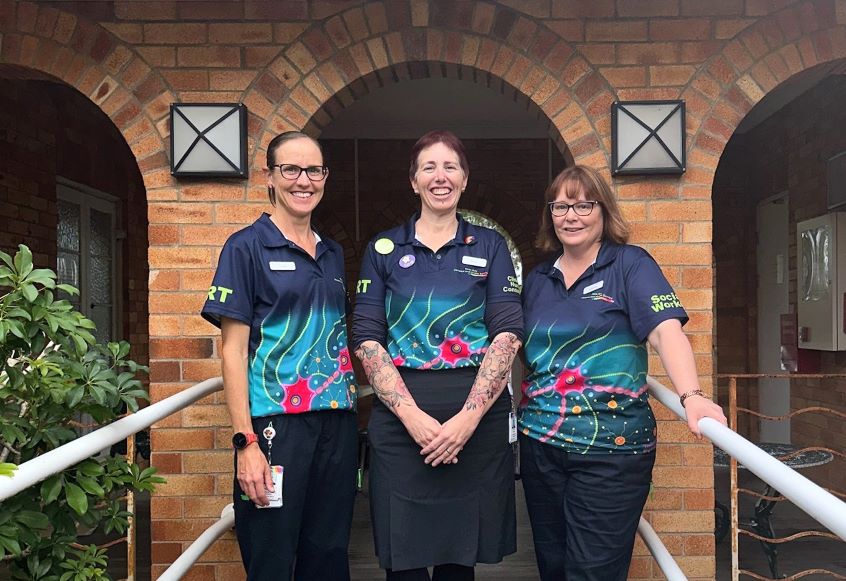
Reflecting on the first 12 months of the Behaviour Response Team (BRT) at the Bundaberg and Fraser Coast hospitals has revealed positive outcomes for patients, their families and staff.
The BRT was established to enhance and coordinate care for patients with significantly changed behaviours, focusing on improving patient, community and staff wellbeing.
The team consists of nursing and allied health staff who offer proactive consultations, training, and resources to help anticipate and manage behavioural challenges before they escalate.
Team Leader of Integrated Care Rehabilitation Rebecca Nieman said the team works with the person and their carers to provide support in the right place and time.
She explained there are many causes for changed behaviour and some of those may relate to communication difficulties, unfamiliar surroundings, infection, pain and reaction to restriction of movement, which is often necessary to protect the privacy of other patients.
“We provide a hybrid model which spans both inpatient and community-based care,” Rebecca said.
“In the community a referral pathway has been introduced for GPs.
“This means we can collaborate and assist with clients who are not NDIS eligible, such as those with Dementia or other age-related cognitive decline who demonstrate significant behavioural change.
“Our aim is to prevent these clients arriving in the emergency department in crisis, especially when carers may have burned out.”
The team works towards providing support with tools for carers and loved ones to care for people with changed behaviours and to reduce hospital admissions due to carer strain.
When patients are in hospital, the BRT service improves their dignity, comfort and safety. It improves the likelihood of being able to discharge from hospital to a more home-like environment quicker.
“We do not take over patient care but instead work with teams to provide support and suggestions,” Rebecca said.
Overall, since starting the BRT service in February 2025, the team has responded to over 450 referrals, with the vast majority of these being hospital inpatients.
Rebecca said success was marked by many heart-warming examples where the person-centred approach had significantly improved patients’ quality of life and alleviated distressing symptoms. This has allowed people to return home to loved ones or successfully transfer to a much more home-like setting such as Residential Aged Care or Specialist Independent Living.
“We have made novel use of a clinical measurement tool to track changes in behaviour using a traffic light and pie chart system,” Rebecca said.
“This demonstrates the proportion of time that a person is distressed or agitated.
“As management strategies are implemented, the clinical measure demonstrates whether the strategies are being effective. The pie graphs can then be added to clinical reports and referrals.
“This has been instrumental in reassuring potential carers or facilities that with adherence to often fairly simple behaviour support measures, someone can be managed in a particular setting.”
For the BRT, working closely with staff is key in supporting them to identify triggers and provide strategies for earlier de-escalation. This also reduces the risk of occupational violence against healthcare staff.
To discuss potential BRT referrals or to find out more information from the team, phone 4303 8246 (Bundaberg) or 4184 1818 (Fraser Coast).